Description
Through his father, a veterinary surgeon, Georges Hilbert developed an early passion for the animal world. It was, however, through close observation of animals at the Jardin des Plantes that he learned his craft as a sculptor. He was particularly drawn to the practice of direct carving, a technique revived at the very beginning of the century by Joseph Bernard. Hilbert himself learned it from the Spanish sculptor Mateo Hernandez (1885–1949), whom he met at the Jardin des Plantes and for whom he worked. Like Hernandez, Hilbert adopted the method of confronting the block of stone directly, working on site and in front of the model, without necessarily relying on drawings or preparatory sketches. He likewise favored the hardest materials: diorite, green schist, agate, obsidian, granite, and marble—such as that used for the present sculpture.
In 1930, a study trip to Egypt introduced him to the animal sculptures of the Pharaonic period. The purity and austerity of ancient Egyptian animal statuary left a lasting impression on him. His subsequent encounter with François Pompon further encouraged him to focus on expressing the behavior and character of the animal, while preserving the synthetic line so dear to the master.
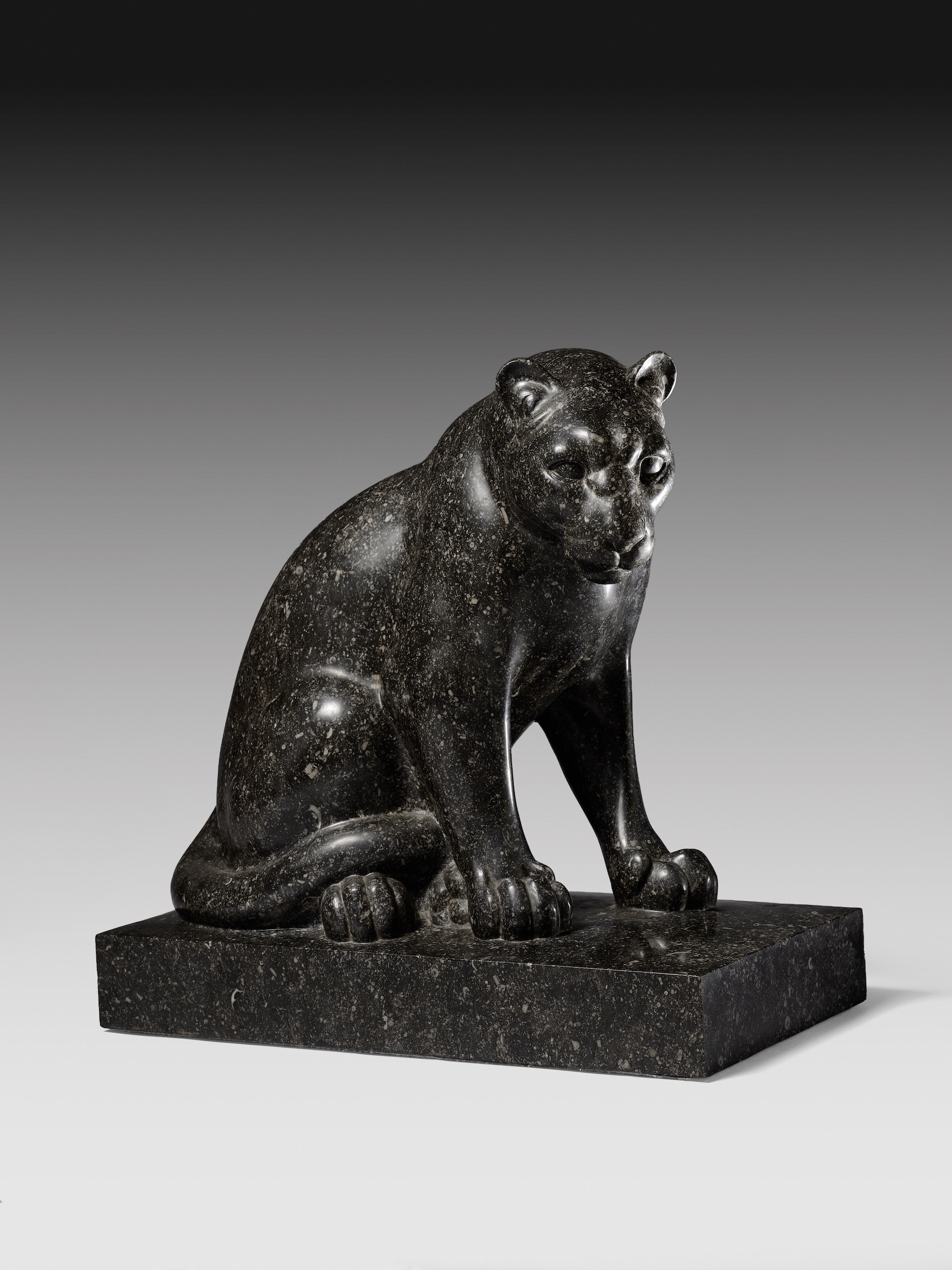
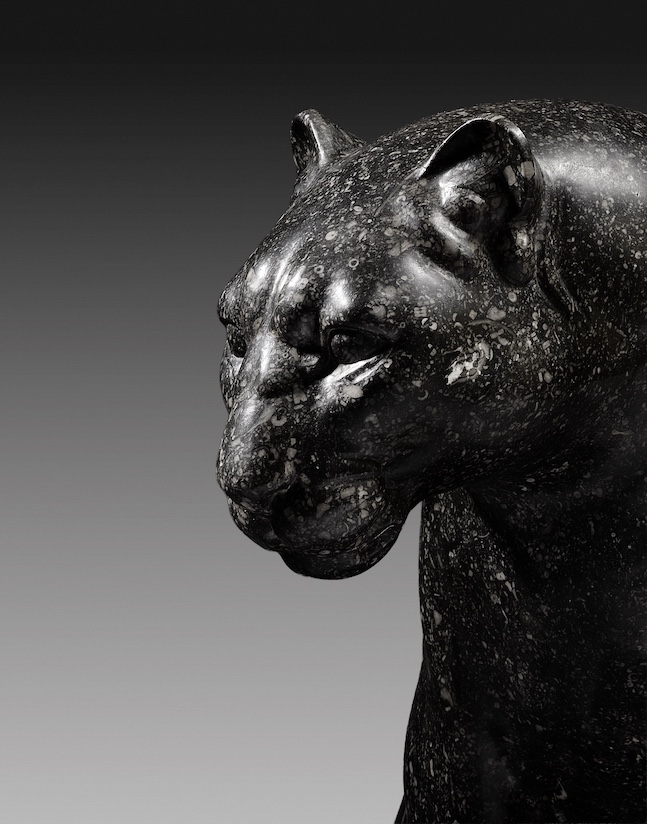
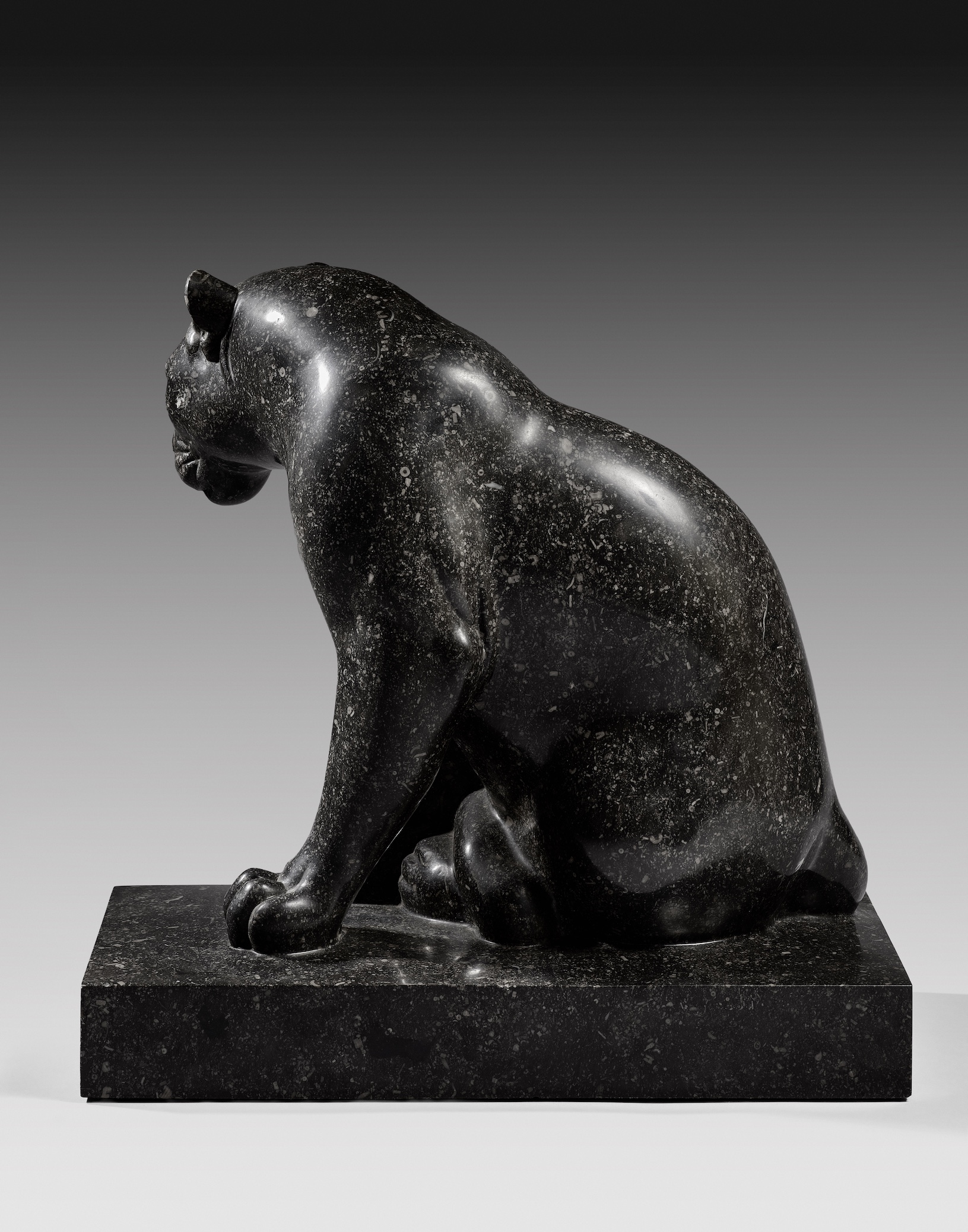
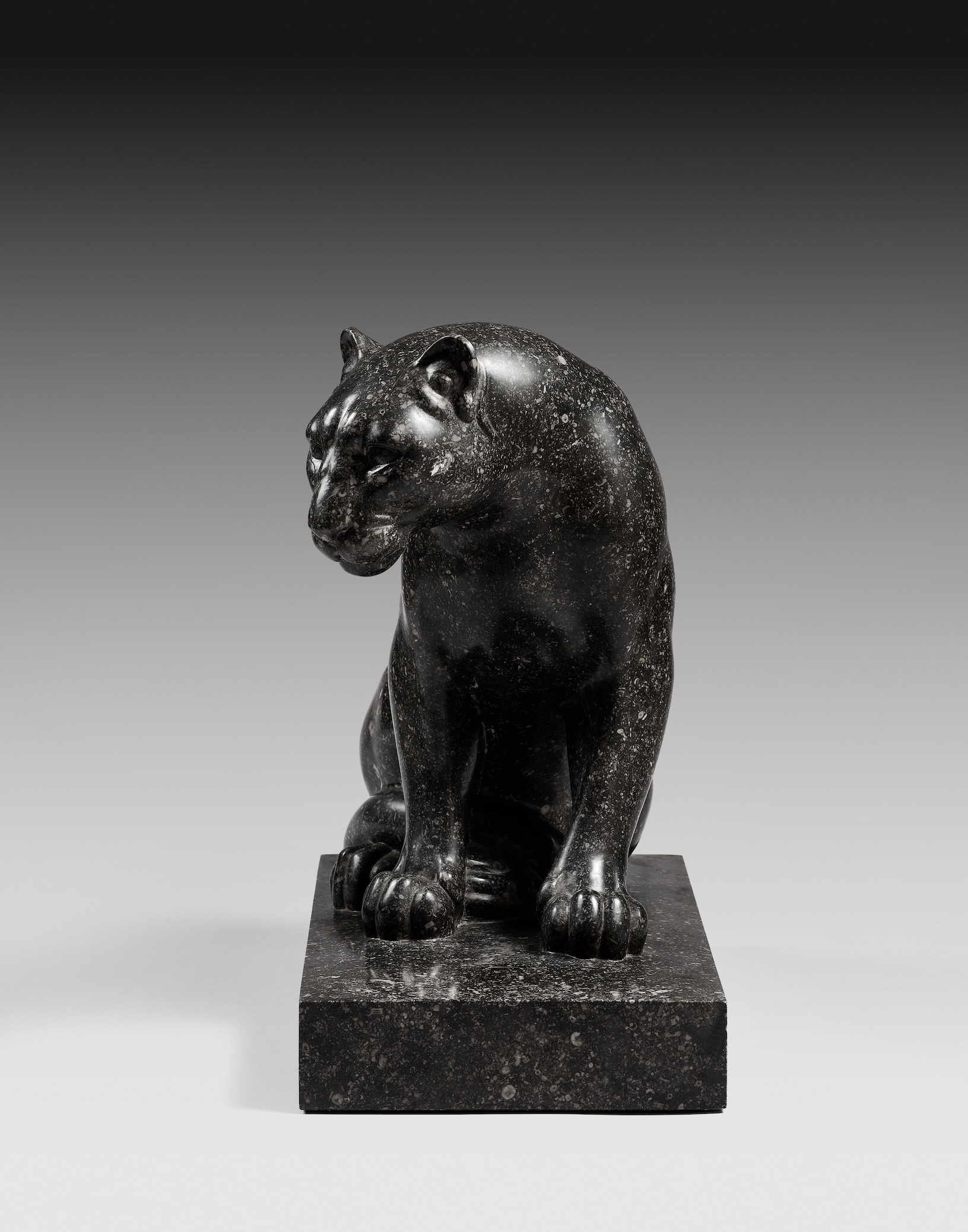
This evolution is particularly evident in the present Male Panther, dated 1947, when compared with a Puma executed shortly after Hilbert’s return from Egypt. Both works are carved in hard stone and share a comparable formal simplicity. In each case, the animal is seated upright on its haunches, with the forelegs extended and the tail folded alongside the hind limbs. Yet whereas the Puma adopts a rather stiff and restrained pose, the Male Panther, by contrast, appears far more natural and animated. Its head, slightly inclined forward, the barely open muzzle, and the more pronounced whiskers lending a subtle tremor to the lips, suggest an intense attentiveness to something unfolding before it. The musculature, articulated through deep, confident carving, is more pronounced and elegantly conveys the latent power of the beast, emerging from the dark mass of the block through the brilliant reflections of the polished black marble.
This is a mature work in which Georges Hilbert achieves a remarkable balance between formal modernity and figurative clarity, imbued with great sensitivity.
The sculpture is a unique piece, carved from a magnificent marble known as Petit Granit Belge, recognizable by its fine texture and characteristic fossil inclusions.