
Description
Often compared to medieval visual artists, whose robust expressiveness he embraced, Gaston Le Bourgeois undoubtedly owed much of his distinctive manner to his early training. Born in the Calvados, he followed his father — a stonecutter specializing in historic monuments — across France from a very young age. Through this experience, he became deeply familiar with sculptural fragments and architectural elements requiring restoration, particularly those from medieval churches. This developed his taste for sculpture, while he learnt his craft through practice, like a journeyman.
He specialized in relief and sculpture in the round designed to integrate seamlessly into exterior or interior designs: fence or stair posts, pillar finials, wall or decorative paneling, roof ridge ornaments, capitals and related architectural elements. He demonstrates a thorough understanding of architectural supports in his work and reveals a remarkable ability to adapt ornament inventively to structural constraints, much like Romanesque stone carvers. He favored animal subjects, treated in a modern spirit with great restraint and a keen sense of formal synthesis, always adapting the composition to its intended location and function.
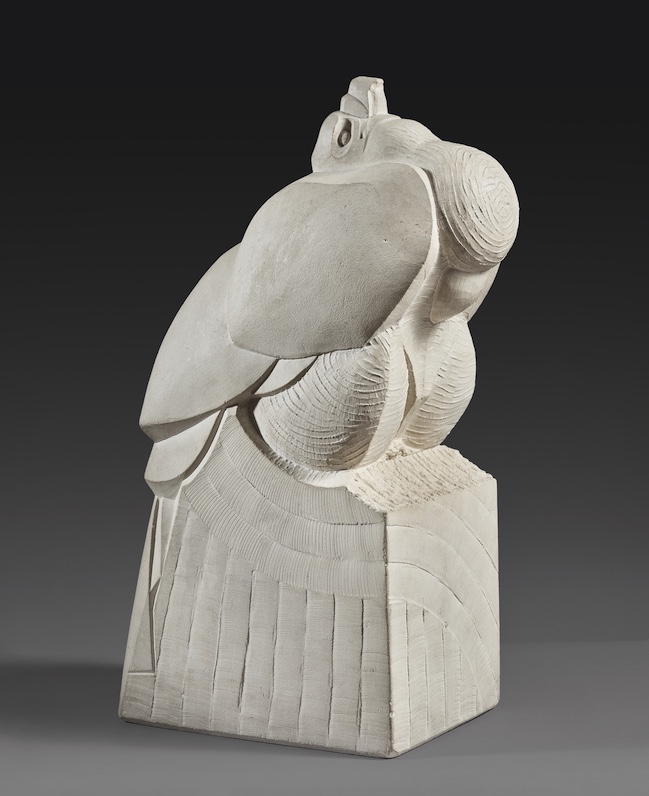
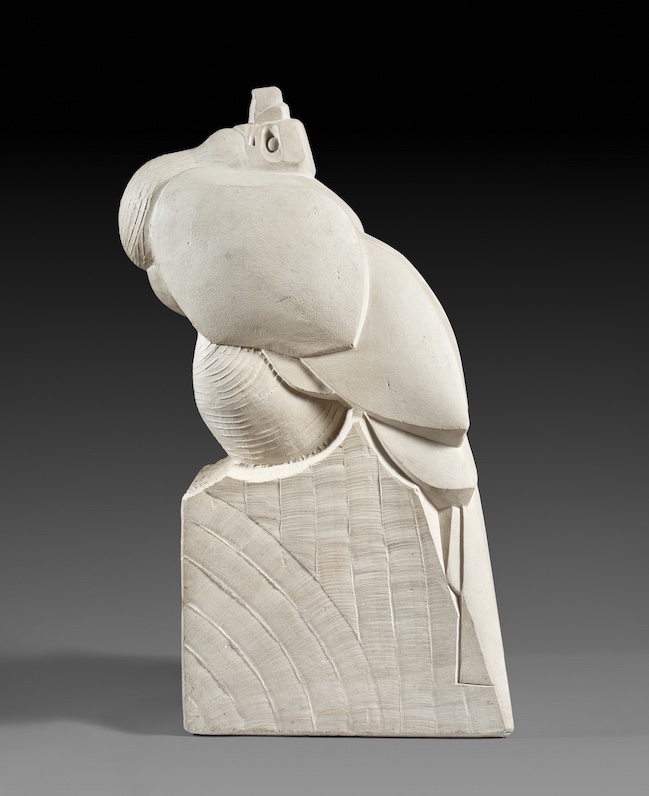
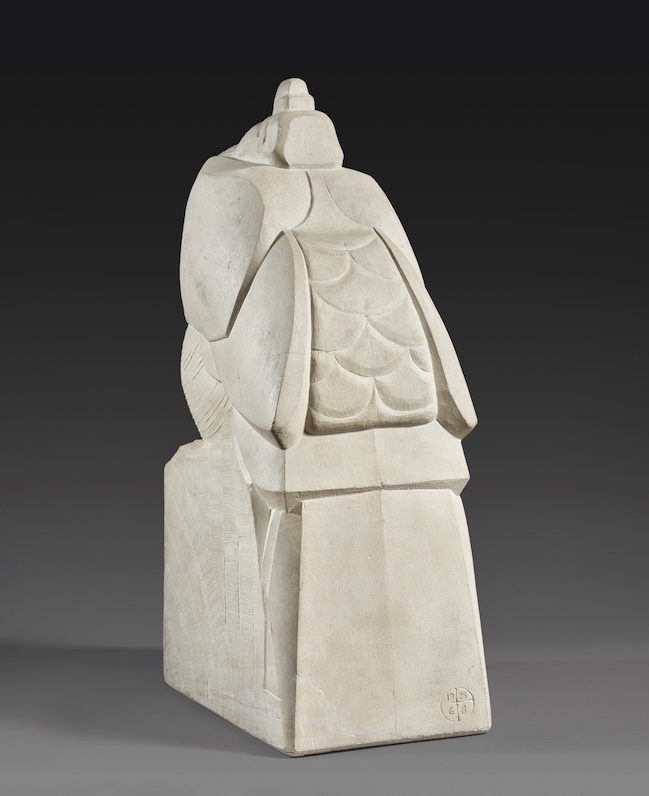
The present White-Headed Vulture is a striking example of this. Executed during the 1925 International Exhibition of Modern Decorative and Industrial Arts, it was conceived as a decorative architectural element intended to crown a post or pillar. With its head drawn in and tilted back as if scanning the sky, its compact body articulated in clear-cut volumes, animated by geometric incisions suggesting plumage, and its integral base, the sculpture perfectly unites ornament and function while fully embodying the Art Deco aesthetic.
For this unique work, Gaston Le Bourgeois selected a particularly fine limestone chosen for its grain, color, texture, and medium hardness, possibly sourced from the region of Grasse. He had already developed a liking for the quality of this stone when executing a war memorial a few years earlier.
The sculpture is in excellent condition, indicating that it was never exposed outdoors.