Description
Inquisitive and drawn to variety, Jules Desbois also turned his attention to the decorative arts. In 1896 he joined a group of artists united around the idea of integrating art into everyday objects, furniture and architecture, with the aim of reconciling the so-called major and minor arts. The group adopted the name L’Art dans Tout (“Art in Everything”), which also became the title of their annual exhibitions.
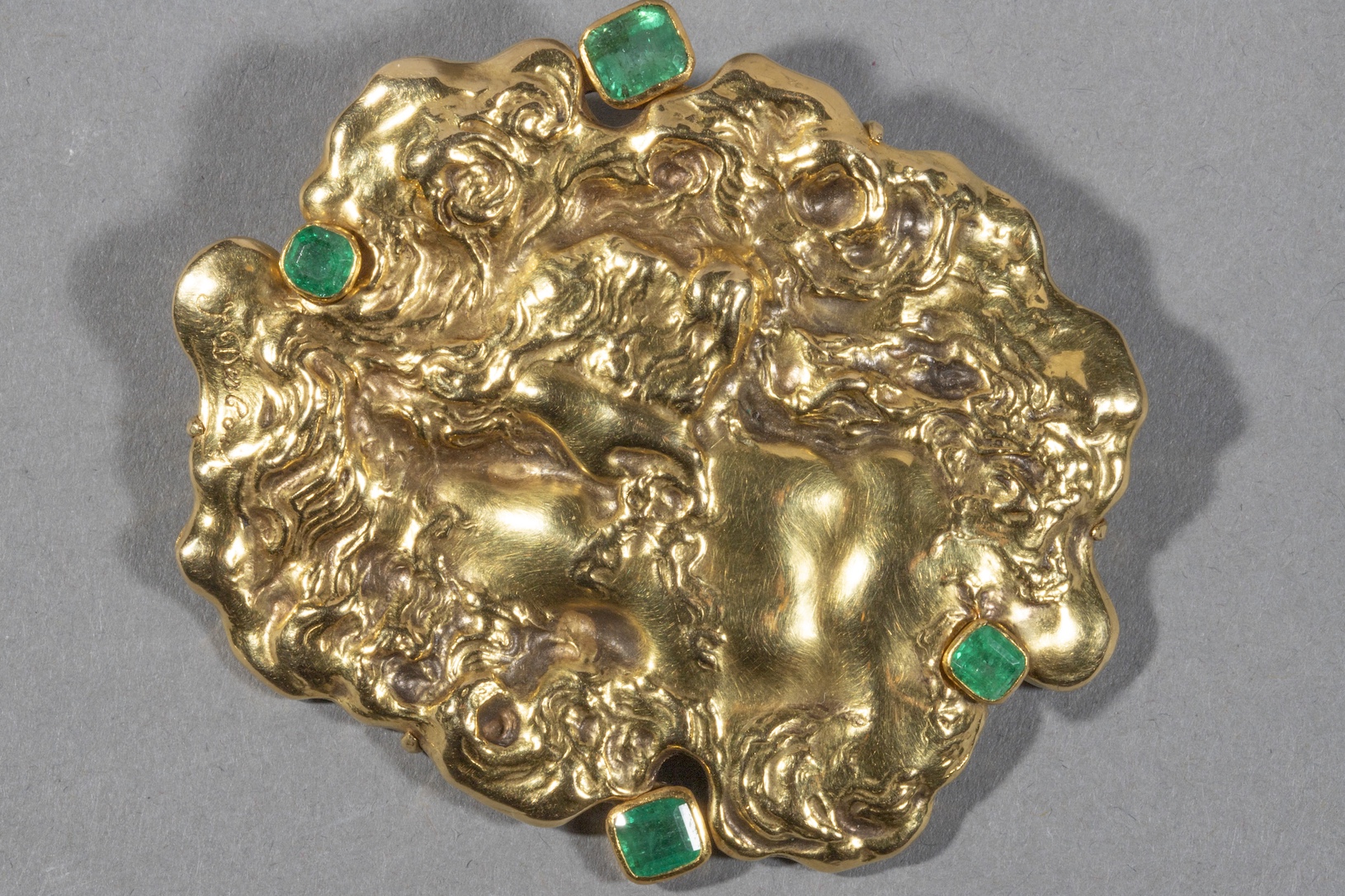
As a champion of socially engaged art, Desbois participated in three of these exhibitions, presenting small objects, tableware (flasks, pitchers, dishes, ashtrays, trays), and jewellery. He produced a considerable number of such pieces, always adopting a refined decorative vocabulary whose themes frequently echoed those of his sculpture — most notably the female body, emerging in low relief from the depth of the material. His preferred medium was pewter, which he helped to bring back to prominence, though he also worked in silver, gold, and precious stones, as in the present brooch.
At the 6th exhibition of L’Art dans Tout, he showed several models for jewellery in plaster. Although our brooch was not included, comparable feminine motifs appear, characterized by abundant flowing hair and expressive hand gestures. Other jewels were exhibited at the Société Nationale des Beaux-Arts in 1903 to considerable acclaim, though it is not known whether the present brooch was among them.
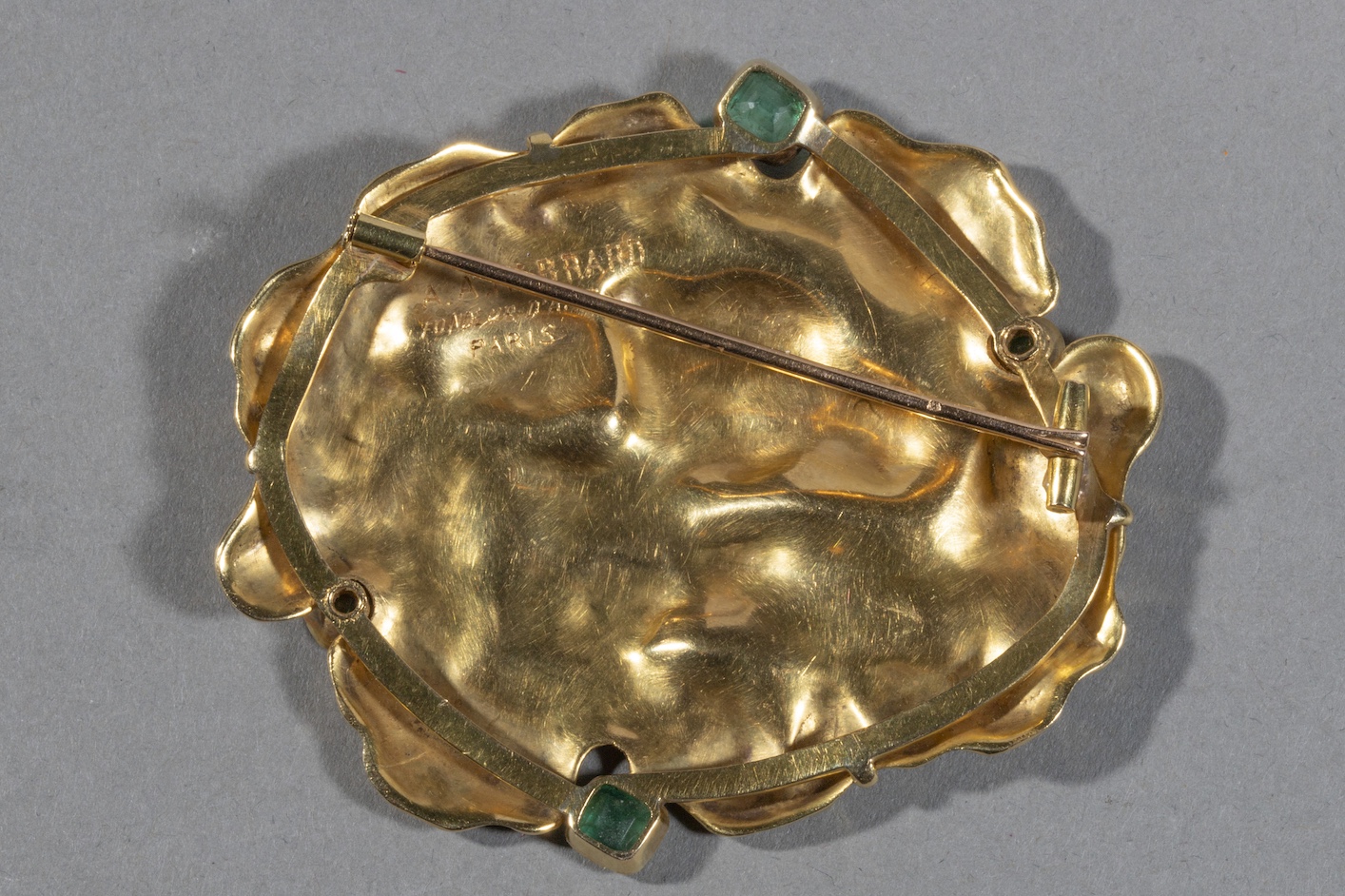
From that year onward, Desbois collaborated with the distinguished art founder and dealer, Adrien-Aurélien Hébrard (1865–1937), who undertook to produce his jewellery in gold. Desbois thus created a series of sculptural brooches in yellow gold adorned with pearls or emeralds. In 1905, at the French Art Exhibition in Berlin, he presented under no. 73 a “brooch, patinated gold and emerald.” Could this be our jewel — also in gold and set with four emeralds framing, against a background of foaming seawater, a delicately modeled female figure seen from behind, raising her left hand as if to gather her hair? The model was in any case reproduced in 1908 in a catalogue published by the Maison Hébrard dedicated to women’s jewellery.
It was probably around this time that the founder presented this jewel, both unique and exceptional in quality, as a gift to Jeanne Schwarz (1887–1976), a young dancer who joined the Paris Opera Ballet in 1904 and was appointed étoile in 1919.